Antarctica: The ice that shapes our world
Join leading Antarctic marine geoscientist Dr Laura De Santis for a public event on how past ice-ocean interactions help us understand Antarctica’s future in a warming world.
The recording of this seminar is now available.
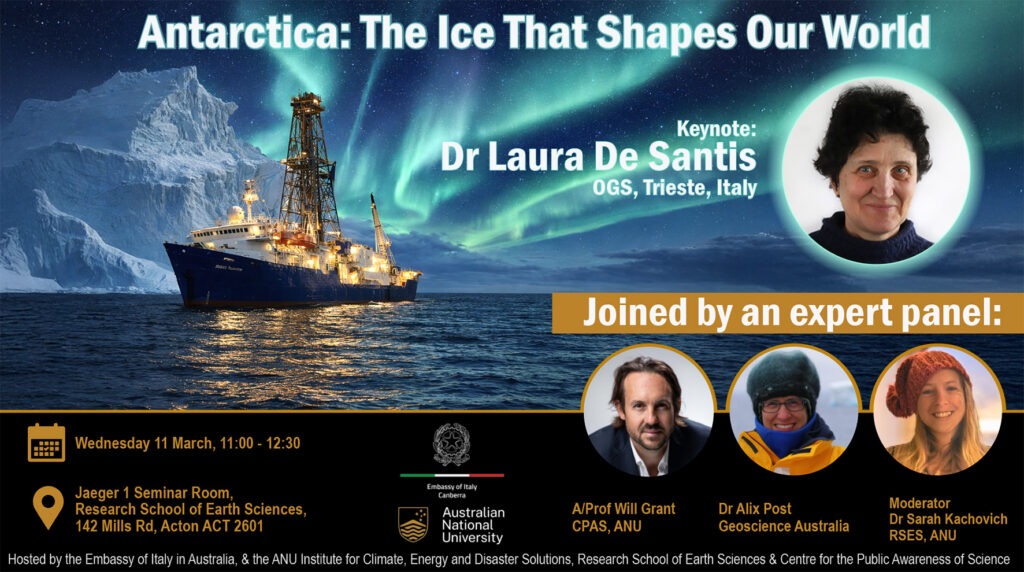
Hosted by the Embassy of Italy in Australia, the Australian National University’s Research School of Earth Sciences (RSES), Institute for Climate, Energy and Disaster Solutions (ICEDS), and Centre for the Public Awareness of Science (CPAS). And in association with IODP-Italia.
Antarctica regulates global sea level, drives deep ocean circulation, and helps stabilise Earth’s climate system. Yet it is also increasingly vulnerable to the very changes it helps control. While it may seem remote, its vast ice sheet holds enough frozen water to reshape coastlines worldwide, making its future a matter of shared international responsibility.
This special public event that explores both the urgency of Antarctic and ocean research and the global cooperation required to carry it out.
Hear from a leading scientist from Italy about the latest discoveries from the Southern Ocean and join our expert panel discussion on why strong international collaboration is essential to understanding Antarctica’s past, anticipating its future, and securing a stable climate and healthy ocean for us all.
Invited Science Talk – Dr Laura De Santis
Ice sheet and ocean interaction, paleoclimate and paleoceanographic record during past glacials and interglacials
The West and East Antarctic ice sheets are the largest and oldest on Earth. Their fluctuations, triggered by orbital and greenhouse gas-induced climate variations, influenced global sea level and ocean circulation well before the Northern Hemisphere ice sheets developed in the Pliocene. Thereafter, the volume of the Antarctic ice sheets changed little compared to their younger Arctic “sisters”, which are much more sensitive to climate variability in the cooler and drier, low-CO2 Quaternary world.
However, sparse geological records from the continental margin suggest that some marine-based sectors of the Antarctic ice sheet retreated during the warmest Plio-Pleistocene interglacials, possibly under the influence of ocean warming and rising sea levels. These sectors may be more vulnerable than others and could reach a critical instability threshold in the near future. Palaeo-ice sheet reconstructions are key to predicting the rate and mechanism of the response of modern ice sheets to climate warming and the resulting global sea level rise.
This talk presents some results obtained from marine geophysical surveys and geological drilling projects in Antarctica, which help to constrain palaeo-ice sheet and ocean circulation models. Palaeoenvironmental and water depth information obtained from sediments to reconstruct palaeobathymetric maps provide a fundamental basis for estimating the volume of the ice sheet, ice flow pathways, and past ice-ocean interactions.
Discussion Panel
Dr De Santis is joined by an expert panel to discuss the importance of international collaboration in Antarctic and ocean science, and address audience questions.
- Dr Laura De Santis (OGS, Italy): Laura De Santis is a Senior Scientist at the Istituto Nazionale di Oceanografia e di Geofisica Sperimentale, Trieste Italy. Her research focuses on Polar continental margins using marine geophysical data, bathymetric maps, and sediment cores for investigating the glacial environment.
- Dr Alix Post (Geoscience Australia): An accomplished Australian marine geoscientist at Geoscience Australia, whose research spans from tropical seas to the Southern Ocean and Antarctic continental margins, with a strong focus on how seafloor processes and environmental conditions shape marine ecosystems and biodiversity.
- Associate Professor Will Grant (Centre for the Public Awareness of Science, ANU): A leading academic in science communication at the Australian National Centre for the Public Awareness of Science at the Australian National University, where he also serves as Associate Dean Higher Degree Research in the College of Systems and Society. In 2024 he participated as a science communication researcher on an International Ocean Discovery Program (IODP) expedition drilling into the Japan Trench earthquake zone, studying both the science and how researchers communicate their work.
The panel discussion will be moderated by Dr Sarah Kachovich (ANZIC, ANU): Dr Sarah Kachovich is a marine micropaleontologist and the International Scientific Drilling Program Manager for Australia and New Zealand (ANZIC) based at the Australian National University. Her research spans using microfossils to address key questions in biostratigraphy, ocean anoxia and tectonic history.