Next generation of marine experts set sail on national sea-training voyage
Students from universities across Australia will conduct real-world research at sea, gaining hands-on experience to help shape Australia’s next generation of marine experts.
Twenty students from across Australia will gain hands-on experience at sea aboard CSIRO research vessel (RV) Investigator, as part of a national sea-training program preparing the next generation of marine experts.
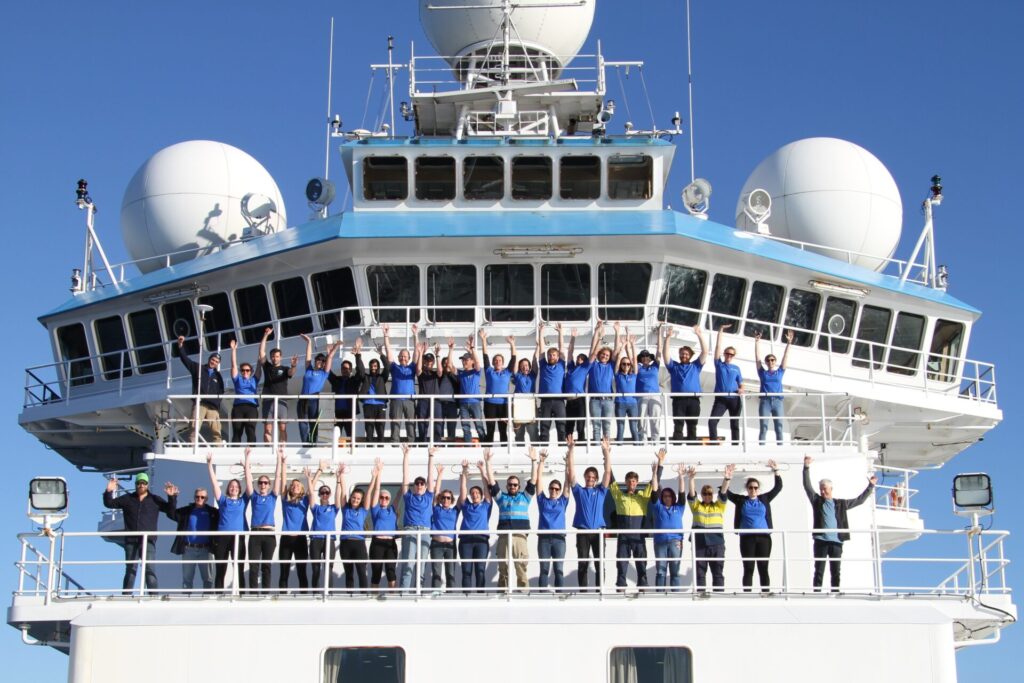
Students will be departing from Fremantle today on a 13-day voyage to Hobart, receiving training in the vessel’s scientific systems and conducting real-world science including seafloor mapping, sediment sampling and oceanographic surveys.
The voyage is part of CAPSTAN – the Collaborative Australian Postgraduate Sea-Training Alliance Network – a national tertiary sea-training initiative of Australia’s national science agency, CSIRO, the University of Tasmania’s Institute for Marine and Antarctic Studies (IMAS), and the Australian and New Zealand International Scientific Drilling Consortium (ANZIC).
CAPSTAN Director, Dr Pier van der Merwe from IMAS, said the sea-going experience was invaluable for developing Australia’s next generation of marine experts.
“You can teach the theory in a classroom, but it’s when students are out on the water that the pieces start to fall into place,” Dr van der Merwe said.
“They see the conditions scientists work in, the technology used to collect data, and how teams collaborate to solve research questions”
“For many students, being part of the CAPSTAN program is a life-changing experience that often shapes the direction of their careers.”
Now in its second year following the program relaunch in 2024, CAPSTAN brings together marine science students and trainers from 18 Australian universities involved in diverse studies including Earth sciences, oceanography, marine ecology, Antarctic studies, and more.

Dr Sarah Kachovich, ANZIC Program Manager and CAPSTAN trainer said that “CAPSTAN gives students a rare chance to experience life and research at sea, working alongside leading scientists.
“Programs like this are essential for building the next generation of researchers, giving participants the practical skills and confidence to contribute to major scientific projects in Australia and around the world.
“By supporting initiatives like CAPSTAN, we’re helping future scientists to better understand our oceans and the Earth’s systems beneath them.”
Dr van der Merwe said the voyage will give students the chance to contribute to real-world research while learning how science is conducted at sea.
“During the voyage, we’ll visit the Bremer Canyon Region to repeat sampling and surveys first carried out during a previous CAPSTAN voyage in 2017,” he said.
“Students, in collaboration with the CSIRO technical team onboard, will also plan and carry out a survey of an historic shipwreck along the route on behalf of the Australian Government’s Department of Climate Change, Energy, Environment and Water’s Underwater Cultural Heritage team.”
“In addition, students will contribute to the investigation of a significant environmental issue, collecting ocean data offshore of the persistent harmful algal bloom near Kangaroo Island in South Australia to support ongoing research by the South Australian Research and Development Institute.”
CAPSTAN Voyage Manager, Dr Ben Arthur from the CSIRO Marine National Facility, said students will be familiarised with multidisciplinary scientific systems, equipment and operations on RV Investigator over the course of the voyage.
“CAPSTAN offers an incredible learning opportunity for students, and they’ll be involved in a diverse range of operations to collect data and samples to support research that addresses real-world challenges,” Dr Arthur said.
“Importantly, through CSIRO’s Indigenous Science Engagement Program, students and trainers will learn from Indigenous knowledge holders as part of a pre-voyage workshop to increase understanding of Indigenous knowledge systems.
“The training program is designed to be like the multidisciplinary research we deliver during each of our science voyages, so that students get a wide exposure to science operations at sea.”
The CAPSTAN voyage departs Fremantle on Thursday 23 April, and will complete a 13-day transit through the Great Australian Bight via continental shelf waters of southern Australia, before arriving in Hobart on Tuesday 5 May.
The CAPSTAN program is a maritime education and training initiative of Australia’s national science agency, CSIRO, the University of Tasmania’s Institute for Marine and Antarctic Studies (IMAS) and the Australian and New Zealand International Scientific Drilling Consortium (ANZIC). RV Investigator is part of the Marine National Facility, national collaborative research infrastructure funded by the Australian Government and operated by CSIRO on behalf of the nation. CAPSTAN partners CSIRO and the Australian and New Zealand International Scientific Drilling Consortium (ANZIC) receive funding for this activity from the Australian Government through the National Collaborative Research Infrastructure Strategy (NCRIS).