We are thrilled to relaunch our Distinguished Lecturer Series.
The Australian & New Zealand International Scientific Drilling Consortium (ANZIC) is relaunching its Distinguished Lecturer Series, starting September 2025, to bring the exciting discoveries of scientific drilling to the wider geosciences community in Australia and New Zealand.
Modelled after the long running and popular US Ocean Discovery Lecture Series (est. 1991) and the ECORD Distinguished Lecturer Programme (est. 2007), this sponsored initiative is for an in-person lecture series to be given by leading scientists involved in the scientific drilling programs: International Ocean Discovery Program (IODP) and/or International Continental Scientific Drilling Program (ICDP); or equivalent national marine geoscience or land based drilling programs. Selected lecturers will be funded to travel to research centres, organisations, and universities.
Our 2025 Distinguished Lecturer
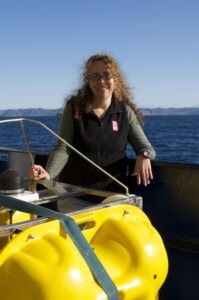
Our very distinguished lecturer for 2025 was Prof. Laura Wallace. Laura is a GEOMAR geophysicist and ANZIC’s first and only female Co-Chief Scientist on an IODP expedition!
As a global pioneer in slow slip event (SSE) research, Laura led IODP Expedition 375, installing one of just two borehole observatories in the Southern Hemisphere, at New Zealand’s Hikurangi Subduction Zone. Her groundbreaking work is unlocking the secrets of fault mechanics and revolutionising seismic hazard prediction with cutting-edge, long-term monitoring.
Laura’s tour has now ended, but you can listen to her talk in this recording.
Unlocking the secrets of slow slip events with IODP drilling
The discovery that slow slip events (SSEs; lasting days to years) play a major role in the accommodation of plate motion at subduction zones has transformed our understanding of fault mechanics and earthquake processes. However, many outstanding questions remain regarding the physical processes and properties that promote slow slip event occurrence, and their distribution. The northern Hikurangi subduction zone offshore New Zealand hosts the world’s shallowest, well-documented slow slip events, and presents a globally unique opportunity to use scientific ocean drilling to reveal the physical properties and processes that produce shallow SSEs. The close proximity of these events to the seafloor (less than a few km) offers important opportunities to monitor crustal deformation during SSEs in the very near-field with borehole observatories. During IODP Expeditions 372 and 375, the JOIDES Resolution acquired geophysical logs, cores, and installed two subseafloor observatories on a transect across the northern Hikurangi subduction margin. The coring and logging data provide unprecedented insights into the fault rocks entering a slow slip source region, and reveals that lithological heterogeneity and the healing characteristics of the fault rocks play a major role in shallow SSE occurrence. The Hikurangi borehole observatories have detected pore pressure changes as a proxy for volumetric strain during several SSEs, and provide an unparalleled view of the spatio-temporal distribution of both spontaneous and dynamically triggered slow slip events near the trench. Results from IODP borehole observatories at Hikurangi, Nankai, and Costa Rica demonstrate that such observatories provide the highest fidelity measurements currently available of offshore crustal strain, and should be installed and utilized more widely.