Connecting coring campaigns across the region
ANZIC invites researchers, students, and collaborators to participate in a one-day hybrid workshop focused on developing offshore and onshore coring proposals in the Australasian region.
The workshop will take place on Tuesday 7 July in Sydney, alongside the AQUA 2026 Conference (Australasian Quaternary Association). It will bring together scientists, infrastructure specialists, operational experts and proposal teams to align ideas, build collaborations and develop competitive proposals for international drilling programs.
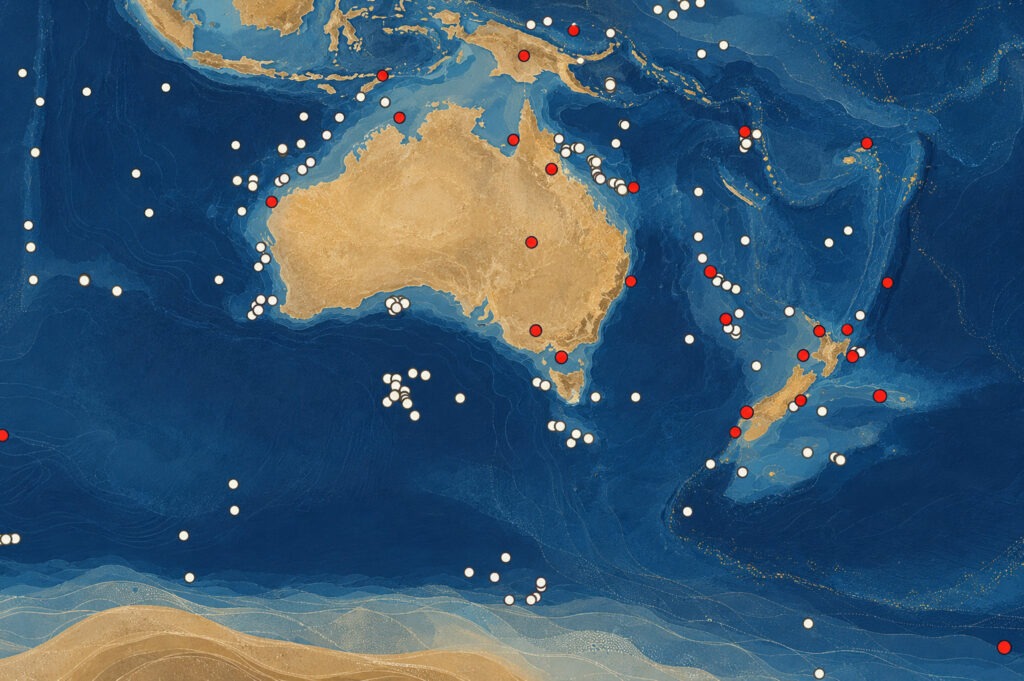
Location of emerging proposals (red) and previously drilled sites (white).
Across the region, more than 30 science ideas and emerging proposal concepts have already been identified, spanning climate change, tectonics, carbon cycling, volcanism, paleoclimate, environmental change, and human history.
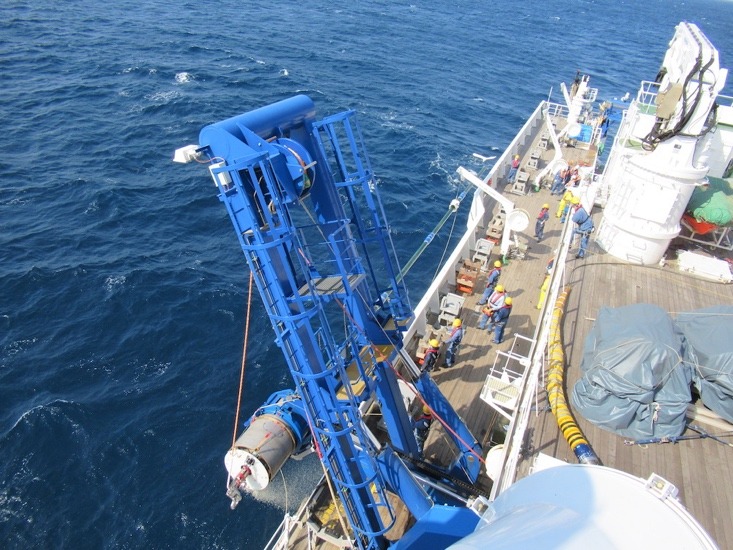
Many of these ideas rely on Giant Piston Coring (GPC) offshore and ICDP (International Continental Scientific Drilling Program) lake and coastal drilling on land.
By coordinating these proposals, the community can leverage shared infrastructure, strengthen scientific outcomes and maximise opportunities when vessels and drilling platforms operate in the region.
The workshop will place a strong focus on infrastructure planning and operational capability, including Giant Piston Coring systems, lake drilling infrastructure, seabed conditions, site survey requirements and the practical pathways needed to progress projects toward successful international proposals.
By bringing the community together to transform ideas into strong proposals, we’ll ensure projects are strategically aligned and well positioned for submission to programs such as IODP³, ICDP, US-SODCO and other international partners.
ANZIC is ideally placed to host the workshop and support this work, leveraging the strength of research across our regional consortium along with our deep international ties and key memberships.
Join us!
The workshop has already attracted more than 70 registrations from 14 countries and 32 institutes and organisations, highlighting the strong international interest in coordinated Australasian coring and drilling initiatives.
Virtual registrations remain open and will not sell out.
Where? When?
Tuesday 7 July, 2026. From 8:30am to 5pm, followed by dinner (dinner registration is required).
At the Galleries Cambined, John Niland Scientia Building, University of New South Wales (UNSW) Sydney, Australia
Held in conjunction with AQUA 2026 Conference.
Cost
The Workshop is hosted by ANZIC and is Free for participants.
Updates
Workshop objectives
- Build a collaborative Australasian coring and drilling community
- Consolidate and strengthen proposal ideas across the region
- Identify shared infrastructure, site survey, and operational needs
- Support proposal development and build submission readiness
Workshop program
| 8:30 | Registration and Coffee | |
| 9:00 | ANZIC Chair Welcome and Workshop Objectives | |
| 9:15 | Proposal Process Considerations | |
| 9:30 | Technical Talks about Infrastructure Capabilities Followed by a Panel Discussion and Q&A | |
| 10:40 | Morning Tea | |
| 11:00 | Science Talks (see details below) Active Drilling Projects | |
| 11:30 | Science Talks (see details below) Proposal Ideas Cluster One | |
| 12:20 | Science Talks (see details below) Proposal Ideas Cluster Two | |
| 13:00 | Lunch | |
| 14:00 | Science Talks (see details below) Proposal Ideas Cluster Three | |
| 14:45 | Science Talks (see details below) Short pitches and emerging concepts | |
| 15:10 | Breakout Sessions | |
| 16:40 | Reconvene – Project Reports and Next Steps | |
| 17:00 | ANZIC Chair Closes Workshop | |
| 18:30 | ANZIC Hosted Dinner (sold out) | |
These sessions are open to students, early-career researchers, and anyone interested in scientific drilling and coring activities across Australasia.
Importantly, both virtual and in-person participants will have the opportunity during the day to give short three-minute pitches for new ideas, emerging concepts or potential collaborations. This is designed to encourage new connections, identify overlapping interests and help generate future proposals.
Science Talk Program
Active Drilling
| Speaker | Topic |
|---|---|
| Ai Li (Institute of Earth Environment, Chinese Academy of Sciences) | ICDP Weihe Basin Deep Drilling Project: Mio–Pleistocene Asian hydroclimate variability and dynamics |
| Bob Musgrave (University of Newcastle) | IODP3 SPARC Expedition 504S: The volcanic ash record from the Ontong Java Plateau — testing models of subduction reversal and wind transport in the western equatorial Pacific |
Proposal ideas: Cluster One
| Speaker | Topic |
|---|---|
| Simon Haberle (Australian National University) | Bass Strait: submerged land-bridge |
| Alexander Francke (University of Adelaide) | Connecting Indo-Australian Monsoon and Palaeo-groundwater recharge by Land to Sea Drilling (CAMP L2S) |
| Paul Kuman (University of Papua New Guinea) | Offshore drilling in the Manus Basin, Bismarck Sea, Papua New Guinea |
| Simon Haberle (Australian National University) | Lake Kutubu, Papua New Guinea: a continuous Quaternary record of globally significant climate and anthropogenic change |
| Myra Keep (University of Western Australia) | Off the Shelf: Comparing mechanisms, frequency, and impacts of shelf collapse on Australia’s northwest shelf and Taranaki |
10-minute facilitated discussion following presentations
Proposal ideas: Cluster Two
| Speaker | Topic |
|---|---|
| Lorna Strachan (University of Auckland) | Chatham Rise seafloor pockmarks and their role in modulating geologic carbon release through glacial cycles |
| Joshu Mountjoy (Earth Sciences New Zealand, Virtual) | Offshore groundwater, New Zealand |
| Paul Augustinus (University of Auckland) | Mid-latitude and tropical climate systems through high-resolution maar lake records from Australia and New Zealand |
| Christina Riesselman (University of Otago) | ICDP FACET: Fiordland Assessment of Climate, Environment and Tectonics |
| Hunter Williams | Lake coring in Koroitj (Tower Hill) – Understanding the climate of the LGM in South Western Victoria (Gunditjamara and Eastern Maar country) |
10-minute facilitated discussion following presentations
Proposal ideas: Cluster Three
| Speaker | Topic |
|---|---|
| Jacobo Martin Nascimento (University of South Pacific, Fiji) | Fiji source-to-sink systems |
| Jody Webster (University of Sydney) | Southern Great Barrier Reef Shelf |
| Tom Hubble (University of Sydney) | SLIDE: Submarine landslides along eastern Australia’s continental margin |
| Joe Cresswell (University of Tasmania, Virtual) | Sub-Antarctic paleoclimate |
| Helen Farr (University of Southampton, Virtual) | ACROSS: Origins of Seafaring to Sahul |
10-minute facilitated discussion following presentations
Quick Talks
Short idea pitches and emerging concepts
| Speaker | Topic |
|---|---|
| Georgia Grant (Affiliation TBC) | Marine heatwaves across the Tasman Sea |
| Open Floor | Additional emerging ideas |