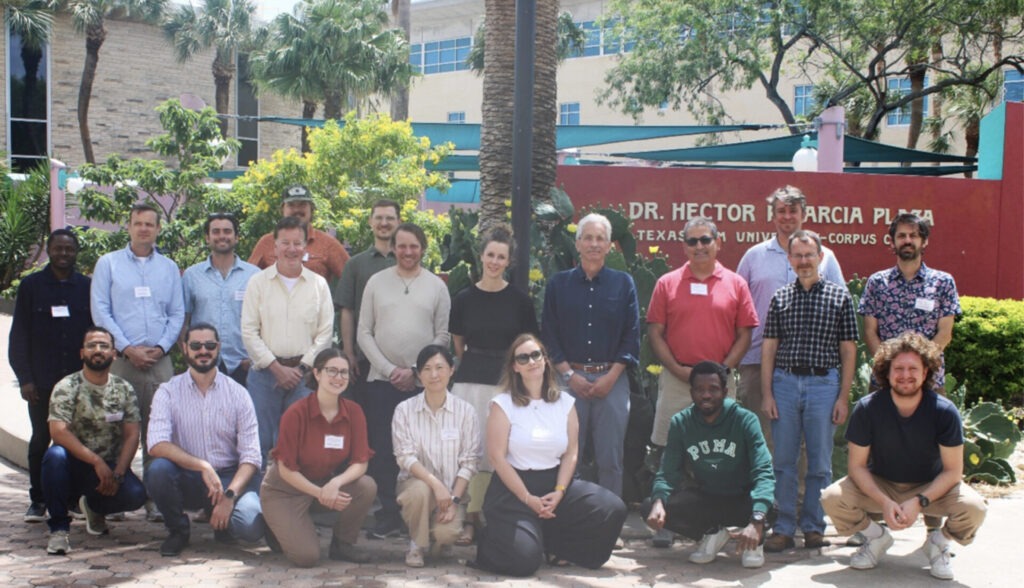
 With financial support from ANZIC, early-career researchers Luca Magri and James Muirhead, along with Lorna Strachan, joined Fynn Warnke as members of the ANZIC contingent.
The workshop built on IODP pre-proposal 924-Pre, which was originally approved in 2018 and received encouraging Scientific Evaluation Panel (SEP) feedback. Since then, significant advances in our understanding of the region have created an opportunity to develop a stronger, more focused, full-drilling proposal.
At the heart of the project lies a fascinating scientific puzzle. During the Late Pleistocene glacial cycles, atmospheric carbon dioxide fluctuated between approximately 190 and 280 parts per million. Scientists still do not fully understand the mechanisms that regulate these remarkably consistent swings in atmospheric CO₂. Recent studies have identified unusual carbon-isotope anomalies associated with the Last Glacial Maximum, suggesting large releases of geologically sourced, or ‘dead’, carbon.
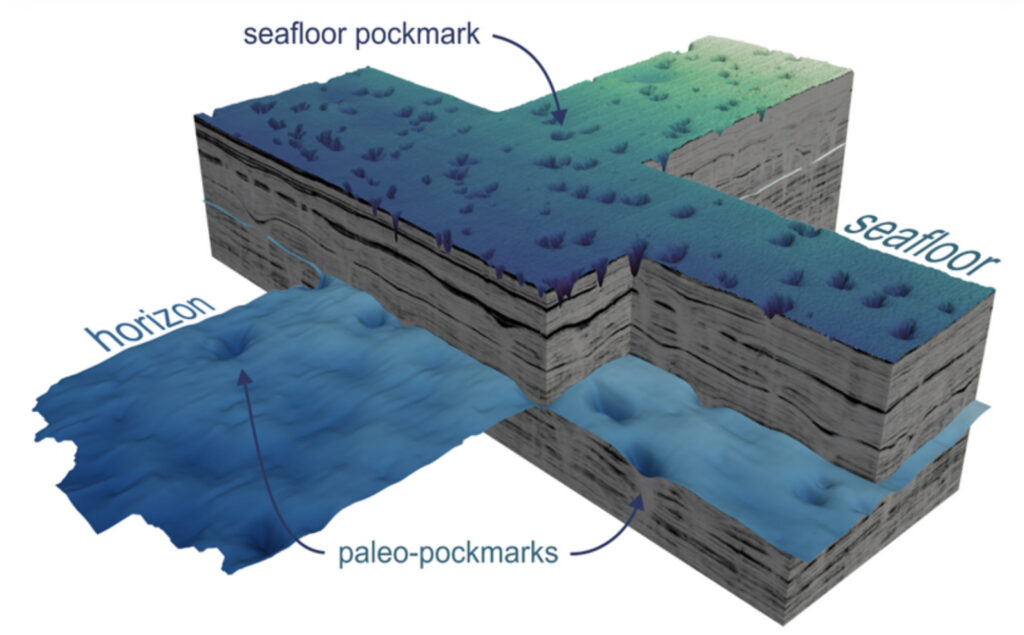
One hypothesis is that the Hikurangi Plateau and overlying carbonates served as a source of carbon-rich fluids, released during deglaciations through abundant seafloor pockmarks, still visible on the Chatham Rise. If correct, this would link deep geological processes associated with an ancient large igneous province to global carbon-cycle dynamics operating over ice-age timescales.
The first day of the workshop focused on the current state of knowledge, featuring a series of engaging presentations on topics ranging from carbon anomalies during glacial periods to the origin and evolution of the Hikurangi Plateau and the formation of pockmarks.
The second day shifted to proposal development. Extensive discussions focused on refining scientific hypotheses and identifying the critical drilling objectives needed to test them. The collaborative atmosphere enabled participants to challenge assumptions, integrate new datasets, and identify drilling sites that could address multiple scientific questions simultaneously.
The workshop also benefited from strong support from both the USSSP and IODP³ offices, who provided advice on drilling capabilities, proposal pathways, and program requirements. Following these discussions, the team intends to submit a joint NSF–IODP³ full proposal.
The next phase will involve forming a proposal-writing team, further refining hypotheses, and developing a compelling drilling strategy. Close collaboration with USSSP, IODP³ and ANZIC will be essential as the proposal moves forward.
For the ANZIC participants, the workshop was an invaluable opportunity to engage directly with researchers from around the world working on some of the most important questions in Earth system science. Early-career researchers Luca Magri, Fynn Warnke, and James Muirhead were particularly active contributors, bringing fresh ideas, thoughtful questions, and new perspectives to the discussions. Their involvement highlighted the important role that emerging scientists will play in shaping the future of international scientific ocean drilling research.
“We gratefully acknowledge ANZIC and Magellan³ for their support, which enabled participation in this workshop and helped strengthen ANZIC’s contribution to an exciting new scientific drilling initiative focused on one of the most intriguing regions of the southwest Pacific,” they said.