
AILAF Grant Writing Workshop
Unlock your research potential with our AILAF Grant Writing Workshop! We’ll guide you through the intricacies of crafting compelling proposals for our AILAF grants.
Unlock your research potential with our AILAF Grant Writing Workshop! We’ll guide you through the intricacies of crafting compelling proposals for our AILAF grants.
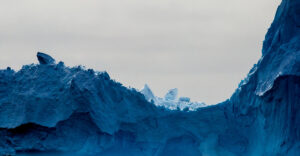
Retrieving ancient DNA from beneath the Arctic Ocean is tricky, but will help reconstruct past ecosystems and predict our warmer future.
![From left: Beth Novak (Assistant Laboratory Officer, IODP JRSO), Christophe Galerne (Physical Properties Specialist, GEOMAR Helmholtz Centre for Ocean Research Kiel, Germany), and Susan Boehm (Marine Laboratory Specialist, IODP JRSO) react excitedly to the sill obtained in a core. (Credit: Tim Fulton, IODP JRSO) [Photo ID: exp385_081]](https://www.iodp.org.au/files/2024/05/02ANUBrochure-300x218.jpg)
Grants of up to $10,000 for Australian Honours & Postgraduates students to cover research, field work or conference attendance.
Applications are now closed.

With Australian ICDP membership imminent, join us to kick-start Australia’s participation in the International Continental Scientific Drilling Program!
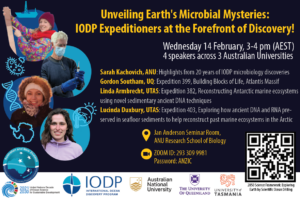
If you missed this exciting seminar highlighting IODP discoveries in microbiology, you can now view the Recording! Four fabulous speakers from across three Australian Universities:
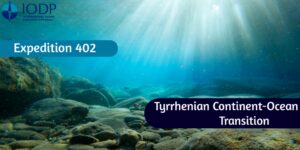
A collection of cores – sampled in a small cross off the coast of Italy – could help settle a debate in plate tectonics that’s been running for over 30 years.
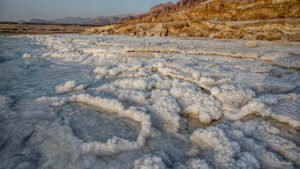
Past changes to the gateway between the Mediterranean Sea and Atlantic Ocean created some phenomenal events and changed ocean circulation and chemistry. Scientist will drill down – on land and under sea – to understand the details.

A project funded by ANZIC’s AILAF Grants aims to investigate.
We all know dust can travel on the wind… and get into everything – usually in small amounts. For researchers like Dr Sam Marx, at the University of Wollongong
“We are going to learn a lot. It’s going to be fascinating to see what the reef cores look like and what they can tell us. My advice – if there’s fundamental scientific questions you want to answer – keep working and keep pushing! Never give up!